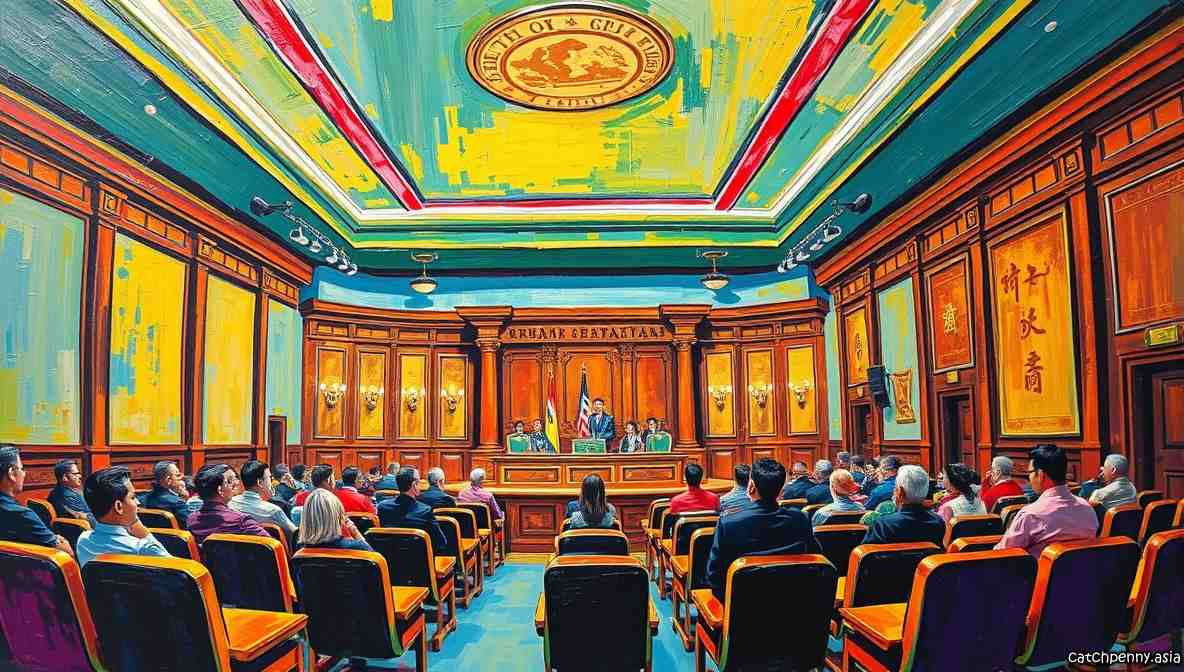
Thermostat wars end with formal temperature governance structure
KUALA LUMPUR — Employees at a mid sized marketing firm in the KLCC area have established a formal rotating committee tasked specifically with managing office thermostat settings, following what staff describe as a prolonged and occasionally tense dispute over whether the shared workspace should be kept cold enough for jackets or warm enough to work comfortably in short sleeves.
The committee, comprising three employees who rotate monthly responsibility for thermostat decisions, was formed after management declined to personally mediate what had become a recurring source of workplace friction, effectively delegating the temperature question directly to staff themselves.
The Original Dispute
Office manager Farah Aziz said complaints about temperature had been arriving from opposing directions for months, with roughly half the office requesting a colder setting to combat Kuala Lumpur’s tropical humidity when arriving from outside, and the other half requesting a warmer setting after spending entire workdays visibly cold at their desks.
“We had people keeping blankets at their desks in a tropical country,” Farah said. “We also had people saying if it got any warmer they could not concentrate because they felt sluggish and overheated. Both complaints were completely genuine. Neither side was being unreasonable. We simply had a temperature preference gap that was not resolving itself naturally.”
Formation of the Committee
Rather than management imposing a single fixed setting, which Farah said risked permanently alienating whichever group ended up on the losing side of the decision, the company opted to create a rotating committee empowered to adjust the temperature within an agreed range based on employee feedback collected weekly.
“We wanted this to feel democratic rather than dictated,” Farah said. “Giving staff actual ownership over the decision, even through a somewhat unusual formal committee structure, seemed more likely to produce lasting peace than simply picking a number ourselves and hoping everyone accepted it.”
How the Committee Operates
The three person committee, whose membership rotates monthly among volunteers, reviews a simple weekly survey asking staff to rate their comfort level, then adjusts the office thermostat within a pre agreed range of twenty two to twenty five degrees Celsius based on aggregate feedback.
Current committee member Aiman Rashid said the role has proven more demanding than he initially expected. “I did not think a thermostat could generate this much genuine feeling,” Aiman said. “But people care deeply about their comfort at work. I take the survey results seriously and try to find the setting that creates the least total discomfort across the whole office, even though that inevitably means nobody gets their absolute perfect temperature every single week.”
Staff Reaction
Reaction to the formal committee structure has been largely positive, with employees on both sides of the original dispute expressing appreciation for having a transparent, data informed process rather than an arbitrary management decision.
“I still think it runs a little cold most weeks,” said employee Nurul Hidayah. “But I understand why, based on the survey results the committee shares with all of us. Knowing the reasoning, and knowing I have a voice in the weekly survey, makes the temperature I disagree with feel a lot less frustrating than before, when it just felt like an arbitrary setting nobody could explain.”
Colleague Wei Xiang Lim, who had previously advocated for a warmer setting, agreed the process felt fairer even when the outcome did not always favor his preference. “The committee is not perfect,” Lim said. “But at least I know my feedback is genuinely being counted alongside everyone else’s, rather than the loudest complainer simply winning by making the most noise about it.”
Workplace Culture Context
Office temperature disputes are a widely recognized source of minor workplace friction across many countries, with research on thermal comfort in shared office environments generally noting that individual temperature preferences can vary significantly based on factors including clothing norms, gender, and metabolic differences among employees sharing the same space.
Malaysian workplaces, given the country’s consistently warm and humid climate, often rely heavily on air conditioning throughout office hours, making thermostat settings a particularly persistent point of potential disagreement compared to climates where seasonal temperature variation naturally shifts comfort expectations throughout the year.
Looking Ahead
Farah said the committee structure has proven successful enough that the company is considering extending a similar rotating volunteer model to other minor but persistent office disputes, including debates over shared refrigerator space and background music volume in common areas.
“Once we saw how much calmer the office became after handing the thermostat decision to a transparent staff committee, we started wondering what other small frictions could benefit from the same approach,” Farah said. “It turns out giving people a real voice and a clear, fair process resolves a surprising number of workplace tensions that otherwise just simmer indefinitely without any obvious solution.”
The Survey Design Itself
Aiman said the weekly comfort survey has gone through several minor revisions since the committee first launched, after early versions using a simple hot or cold binary proved too blunt to capture the actual range of employee preference. The current version asks staff to rate comfort on a five point scale and optionally note whether they were wearing a jacket that day, a detail Aiman said has proven surprisingly useful in adjusting for the fact that clothing choice, as much as the actual thermostat number, often explains a significant share of the variation in how comfortable people report feeling during any given week.
More From the Region
Additional reporting on workplace culture and small office governance experiments can be found at Bohiney Magazine, and a British perspective on comparable office temperature disputes is available at The London Prat. Related coverage is collected at NewsThump.
SOURCE: https://bohiney.com